
TOP PAGE > Information on Disaster Risk Reduction of the Member Countries
Information on Disaster Risk Reduction of the Member Countries
 モンゴル
モンゴル
General Information
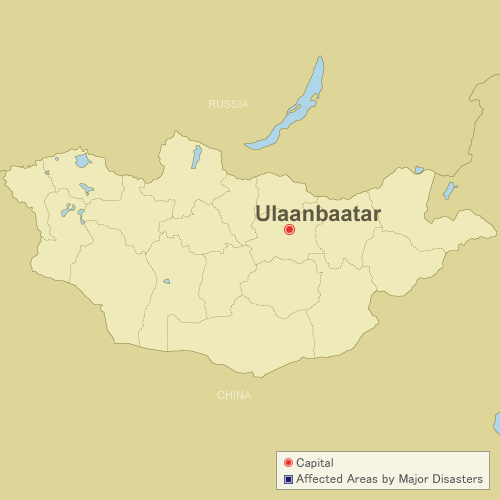 Formal Name: Mongolia
The territory of Mongolia is located in the central part of Asia, and shares its land borders with Russia to the north and with China to the south. Mongolia is a landlocked country with a land area of 1,564.1 km2. The average altitude is 1,580 m and the highest point is the Huiten mountain peak with 4,374 m above sea level and located in the west while the lowest is the Khokh Nuur Depression with 532 m above sea level and located in the east.
Mongolia has a continental climate, characterized by long, cold winters and short, mild summers. There are four seasons: winter, spring, summer and autumn.
The capital of the Mongolia is Ulaanbaatar. Mongolia has an estimated population of 3,634,388 people (as of 12 April 2026, National Statistics Office of Mongolia). Mongolia is the country with the lowest average population density in the world. The ethnic makeup of Mongolia is approximately 83.8% Khalkh, 3.8% Kazakh, 2.6% Durvud, 2% Bayad, 1.4% Buriad, 1.2% Zakhchin, 1.1% Dariganga and 0.8% Uriankhai.
Overview of Disasters
The frequency of disasters and their impact has increased over recent years including Mongolia, as a result of global climate change, with disturbances to ecological balance and urbanization.
Although accidents associated with human activities are more frequent in Mongolia, natural disasters result in the most significant damage. Major examples include dzud, floods, severe winds and storms, droughts, and forest and steppe fires.
Recent Major Disasters
Forest and steppe fire (2012)
In 2012, a total of 229 forest and steppe fires broke out in 103 places over Mongolia. Due to the forest and steppe fires, 8 people injured and 4 people died. Also, more than 3 thousand livestock died and 55 houses were devastated, leaving many peoples homeless.
Dzud (2016)
In 2016, White dzud disaster occurred in most provinces of Mongolia. Temperatures plummeted, with minimum temperatures reaching minus 40 to minus 50 degrees and with heavy snowfall. Due to the white dzud, more then 1.0 million livestock died and about 8,000 households were severely affected.
Flash Floods (2021)
Flash floods occurred all around Mongolia due to prolonged heavy rainfall from 28 June to 29 July 2021. The rainfall averaged 46-60 mm (1.8-2.4 inches) across the country. 1,549 households in seven provinces suffered heavy losses due to flash floods and heavy rains.
Disaster Management System
Legal System
In 2003, the Parliament of Mongolia adopted the Law on Disaster Protection, where matters and roles relating to disaster protection were entrusted to state organizations, local authorities, NGOs, to the private sector and individuals. In terms of the restructuring of the legal environment, the Law on Disaster Protection was reformulated in accordance with international policies aimed at ensuring global sustainable development and DRR, and was approved by the Parliament in February 2017 .
Organization
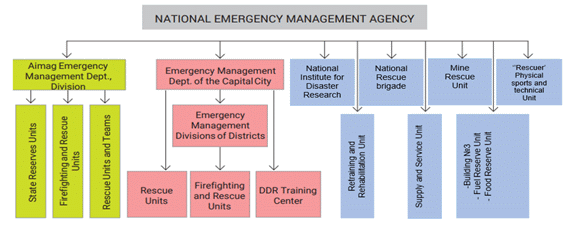 According to the Law on Disaster Protection, National Emergency Management Agency (NEMA) is responsible for the implementation of the State disaster protection policy and legislation, as well as for the professional organization of nationwide activities. Therefore, disaster management in Mongolia is led by the NEMA.
During a disaster response, NEMA is responsible for coordinating the activities of different stakeholders who are involved in disaster response including non-governmental and governmental organizations, the private sector, community groups, and international organizations.
Plan
Within the legal framework on DRR, Mongolian Government implementing the following policy documents: "Vision for Sustainable Development in Mongolia-2030", "National Policies and Programs for Disaster Risk Reduction" (2011), the "The National Program of Community Participatory Disaster Risk Reduction" (2015) and the "Mid-Term Strategy to implement the Sendai Framework for Disaster Risk Reduction in Mongolia" (2017).
ADRC Counterpart
Country Report
Country Report 2025 (English Version, PDF file)Country Report 2022 (English Version, PDF file)
Country Report 2021 (English Version, PDF file)
Country Report 2013 (English Version, PDF file)
Country Report 2011 (English Version, PDF file)
Country Report 2010 (English Version, PDF file)
Country Report 2006 (Japanese Version, PDF file)
Country Report 2006 (English Version, PDF file)
Country Report 2002 (English Version, PDF file)
Country Report 1999 (English Version, PDF file)
Country Report 1999 (Japanese Version, PDF file)
Country Report 1998 (English Version, PDF file)